

 English
 Español
 русский
 中文简体


Home / News / Industry News / vane pump vs gear pump: Applications, Selection Criteria, and Practical Guidance
Industry News
vane pump vs gear pump: Applications, Selection Criteria, and Practical Guidance
When an engineer asks us about the difference between a vane pump and a gear pump, the answer almost always starts with the same question: what liquid are you moving, and how hard is the pump going to have to work? Both are positive displacement pumps, but they handle pressure, viscosity, dry running, and wear in very different ways. As a precision casting foundry that produces gear pump castings and other fluid-handling components, we have seen these differences play out both in real applications and in the foundry.
This guide compares vane pump vs gear pump designs from an operating standpoint and from a manufacturing perspective, so you can make a more confident selection.
How a Gear Pump Works
A gear pump moves liquid by trapping it between the teeth of two rotating gears and the surrounding pump housing. As the gears rotate, the spaces between teeth fill with fluid, carry it around the outside of the gears, and force it into the discharge port when the teeth mesh again. External gear pumps use two identical gears; internal gear pumps use an outer rotor with internal teeth and an inner gear with external teeth.
The design is simple, compact, and relatively inexpensive. Gear pumps are comfortable with high system pressures and handle viscous fluids well. Their main weaknesses include noise, a tendency to generate heat under pressure, and the fact that they are not designed for extended dry running. Because the gear clearances are tight, wear or contamination can quickly reduce volumetric efficiency.
How a Sliding Vane Pump Works
Sliding vane pumps operate with a rotor that sits inside a cylindrical or eccentric cam ring. Vanes in the rotor slots slide outward as the rotor spins, maintaining contact with the ring and creating expanding and contracting chambers. Liquid is pulled into the expanding chamber, then squeezed out through the discharge as the chamber contracts.
One of the most useful qualities of a vane pump is its self-compensating rotor. As the vanes wear, they slide out a little further to keep the seal. This is why vane pumps tolerate dry running better than gear pumps, run quieter, and produce a smoother flow. On the other hand, vane pumps are generally limited to moderate pressures and are more sensitive to abrasive fluids, since wear particles can score the ring and rotor.
Vane Pump vs Gear Pump: Side-by-Side Comparison
The right pump depends on your specific conditions. The table below summarizes how each type behaves in common operating situations.
| Criteria | Gear Pump | Vane Pump |
|---|---|---|
| Fluid viscosity | Excellent for high-viscosity fluids | Good for light to medium viscosity |
| Pressure range | High pressures | Low to moderate pressures |
| Dry-run capability | Poor | Better |
| Noise level | Noisier | Quieter |
| Flow smoothness | More pulsation | Smoother output |
| Wear behavior | Wear reduces clearances and efficiency | Vanes self-compensate for wear |
| Solids tolerance | Not recommended | Not recommended |
| Maintenance | Gear set replacement if worn | Vane replacement is relatively simple |
| Typical efficiency | High at high viscosity and pressure | Better at moderate loads |
Use this as a starting point rather than a shortcut. The actual fluid temperature, pressure, speed, and contamination levels all affect final performance.
How to Choose Between a Gear Pump and a Vane Pump
For thin, clean fluids like solvents, light fuel, or very low-viscosity oils, and where quiet operation matters, a vane pump is often the stronger choice. Its smoother flow makes it easy to work with in light transfer service, and its dry-run tolerance provides a useful safety margin in systems that can be accidentally left unprimed.
For thick hydraulic oil, lubrication oil, diesel, or high-pressure systems, a gear pump is usually more practical. The simple tooth mesh handles higher pressures without the complexity of sliding parts, and the cost is typically lower. Gear pumps are also easier to find in energy-dense packages that can fit into compact machine layouts.
There is no universal winner. Many applications work fine with either design, and the final decision often comes down to familiarity, maintenance schedules, and the specific duty cycle.
Casting Considerations for Pump Components
At the foundry, we see the vane vs gear debate from a different angle. Pump bodies, gear chambers, end covers, and valve plates have to hold pressure, resist distortion, and maintain tight dimensional tolerances. A gear pump body, for example, needs a smooth and accurate bore to control gear clearances and leakage paths. That is why pump castings are one of the most demanding jobs in precision casting.
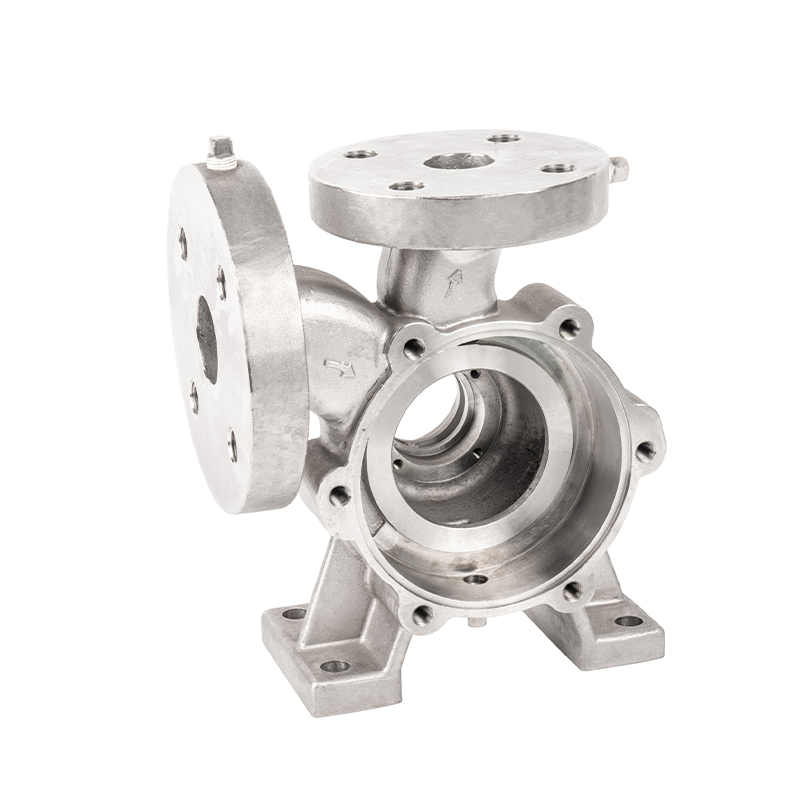
 Custom Stainless Steel Gear Pump CastingsPrecision investment casting delivers near-net-shape gear pump bodies and covers in stainless steel, ensuring tight tolerances and reliable sealing for demanding fluid systems.View Product →
Our experience with gear pump castings has shown that the material choice matters as much as the geometry. Cast iron works well for many hydraulic and lubrication applications, while stainless steel becomes essential for food, chemical, or marine fluids. Investment casting allows us to produce near-net-shape pump bodies and covers with good surface finish, which reduces machining time and keeps sealing faces sound.
For vane pump parts, the cam ring and rotor require precise profiles and a clean internal surface. Although the moving parts are often machined from bar stock, the pump housing is still a casting in most designs, so the foundry has a direct role in pump reliability.
Maintenance and Service Life
Maintenance habits often decide which pump type performs better in service. Sliding vane pumps are designed with replaceable vanes that can be checked quickly, and in many designs the casing remains installed while the cartridge is serviced. Gear pumps, on the other hand, depend more on gear and bearing condition; if the fluid is contaminated or the pump is run dry, the gear set may need to be replaced.
For both types, filtration and fluid cleanliness are non-negotiable. Even the best casting quality cannot compensate for abrasive particles circulating through the pump. Pressure-relief valves should also be checked regularly, because running any positive displacement pump against a closed discharge raises pressure sharply.
If you are thinking about material selection or casting quality for a new pump project, a detailed look at the precision casting process for water pump parts can help you understand how porosity, wall thickness, and surface finish are controlled. Precision casting of water pump components is one of our more detailed guides from a manufacturing perspective.
Final Thoughts
Choosing between a vane pump and a gear pump is not about finding a perfect machine; it is about matching the pump design to your fluid, pressure, noise, and maintenance requirements. Vane pumps offer smooth, quiet, dry-run-tolerant operation at moderate pressures. Gear pumps deliver simplicity, high pressure capability, and excellent performance with viscous fluids.
From a foundry perspective, both designs rely on well-made housings, precise clearances, and durable materials. If you are sourcing castings for either pump family, keep fluid compatibility, pressure integrity, and machining requirements in mind from the start.
RELATED PRODUCTS
Do you have questions? Do not wait, Let's talk!
Contact Us
- Tel: +86-13967888380 / +86-13685858588
- +86-0574-86183698 / +86-0574-86183685
- Fax: +86-0574-86183696
- Email: [email protected]
[email protected] - Add: No. 68, Jiangbin Branch Road, Beilun Xiaogang Joint Development Zone, Ningbo, Zhejiang, China.
QR Code
Copyright © Ningbo Etdz Andrew Precision Cast Co., Ltd. All rights reserved
 Custom Metal Precision Casting Parts Manufacturers
